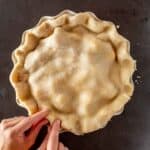
Grandma's Crisco Pie Crust
Whether you're a fan of sweet or savory pies, this Crisco pie crust recipe is sure to be a hit. Thanks to my Grandma's famous recipe, it's easy and quick to put together, and you can fill it with whatever your heart desires. Get ready to whip up the flakiest, tastiest Crisco pie crust that'll have your friends and family asking for the recipe!
Servings: 2 pie crusts
Calories: 1635kcal
Ingredients
- 3 cups all-purpose flour
- 1 tsp. salt
- 2 tablespoons sugar omit for a savory pie
- 1 cup plus 2 tablespoons vegetable shortening cold (*see note)
- ¼ cup plus 2 tablespoons ice water adjust amount as needed
Instructions
- Combine the flour, salt and sugar (omit sugar for savory pies) in a medium bowl.
- Add the cold shortening, then use a pastry cutter or fork to cut it into the flour until it becomes the size of large peas.
- Add the water and mix gently with a rubber spatula until the dough just starts to form a shaggy mass. Add more water one tablespoon at a time as needed until it comes together. Depending on the humidity, you may need several table
- Gently press the dough until it just barely comes together. The dough should not be sticky. Avoid over-mixing or will make it tough.
- Split the dough into two sections, then gently shape them into discs and wrap in plastic. Refrigerate for a minimum of 30 minutes or up to two days. For longer storage, wrap tightly and freeze for up to 6 months.
How to Roll Out the Dough
- When you're ready to assemble your pie, remove one disc at a time from the refrigerator, unwrap and place on a piece of wax paper on top of a large work surface.
- Place another piece of wax paper on top and begin to roll out the dough by starting at the bottom and rolling the pin away from your body.
- Rotate the dough 90 degrees after every 1-2 rolls to help help keep it round. Roll the dough out to about 12 inches around or roughly 3 inches larger than the pie plate.
- Remove the top piece of wax paper, then place the palm of your hand beneath the bottom piece of wax paper and transfer it to the pie plate wax paper side up.
- Carefully remove the remaining piece of wax paper and gently press the dough in to fit.
- For a single crust pie, tuck the loose pieces under, then use your fingers or a fork to crimp the edges and proceed with your recipe.
- For a double crust pie, remove the second piece of dough from the refrigerator and roll it out the same way as the first. Add your filling to the bottom crust, then transfer the rolled out dough on top just like you did the bottom.
- Use your fingers to pinch the top and bottom crusts together to seal in the filling. Tuck and roll the overhang under, then use your fingers or a fork to crimp the edges.
- Cut a few slits to vent the top, then brush all over with the egg wash. Bake as directed or wrap tightly in plastic wrap and freeze for up to 3 months.
How to Blind Bake For a Single Crust Pie
- Transfer the rolled out pie dough to a pie plate and crimp the edges with your fingers or a fork, then in the freezer for a minimum of 30 minutes before baking. This prevents shrinkage!
- Preheat the oven to 375°F.
- Line the frozen crust with a layer of parchment paper or foil, then fill with either dried beans or pie weights, making sure they are evenly distributed.
- Bake for 20 minutes, then remove the parchment and weights and let cool. It's now partially baked and ready to fill and continue baking.
- For a fully baked crust, prick the bottom all over with a fork, then bake for another 20 minutes or until golden brown all over.
How to Bake For a Double Crust Pie
- Preheat the oven to 425°F and make move the oven rack to the bottom third of the oven with enough space to fit the pie.
- Brush the pie all over with egg wash, then place on a parchment lined baking sheet to catch any drips. Make sure there are a few vents in the top of the pie to allow steam to escape.
- Bake for 20 minutes, then lower to 350 and bake for an additional 45 minutes to an hour. it should be golden brown all over with the filling bubbling up out of the vents.
Notes
- *Grandma always used a heaping cup of shortening, which is slightly more than a cup, so I estimate 1 cup plus 2 tablespoons.
- A food processor works really well for making the dough super fast. Just be sure to use quick pulses and be really careful not to overwork it, which could result in a tough crust.
- The amount of water needed to form the pie dough will always vary based on humidity. Always start with less and add more a little bit at a time until it forms a dough. You can always add more but you can't take it out. The dough should feel moistened without a bunch of excess flour, but not sticky and wet.
- Make sure to keep all of your ingredients cold when mixing. If they start to come to room temperature, briefly place them in the freezer or refrigerator until cooled.
- Avoid over-mixing, or it will make the dough tough.
- To keep the dough cold, I like to run my hands under cold water and/or hold onto some ice cubes before mixing or shaping it so the warmth of my hands doesn't affect it.
- A shortening-based dough is easier to roll out between two pieces of wax paper (not parchment paper), unlike doughs made with butter, which is how my grandma does it!
- For longer storage, make sure the dough discs are wrapped tightly and freeze for up to 6 months.
Nutrition
Calories: 1635kcal | Carbohydrates: 155g | Protein: 19g | Fat: 104g | Saturated Fat: 26g | Polyunsaturated Fat: 30g | Monounsaturated Fat: 42g | Trans Fat: 13g | Sodium: 965mg | Potassium: 201mg | Fiber: 5g | Sugar: 12g | Calcium: 31mg | Iron: 9mg
